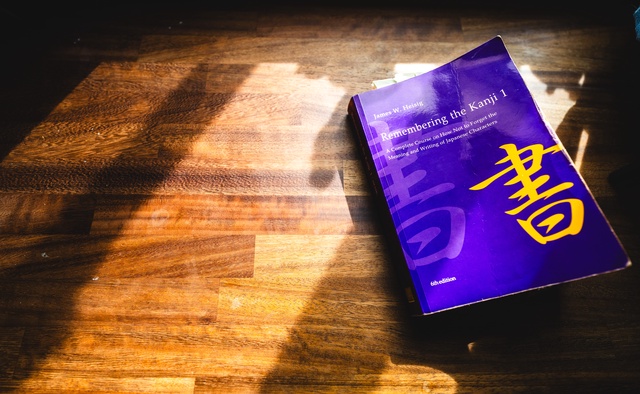

RTK - How I Studied Remembering the Kanji
In the previous post, I talked about why I chose Remembering the Kanji (RTK) in the first place. This time, I want to show you what actually studying it looked like.
Spend five minutes searching online for RTK and you'll quickly find people claiming things like "I learnt all 2,200 kanji in six weeks" or "The first 600 are the hard part, after that the rest just fly by."
I'll just say it... quite frankly, I think these people are full of shit.
Sure, maybe there are people out there who've genuinely managed it. If so, good on them. I certainly didn't.
Maybe I'm being harsh, but at the very least, these people are greatly misleading the vast majority of people. Selling them false hope that this book is an easy win if you want to learn kanji.
I don't consider myself someone who's bad at learning, my software engineering career depends on it. I gave this book absolutely everything I had. I studied every single day for months, built my routine around it, wrote every kanji by hand and still found myself mentally exhausted at times.
The fact is, this book is hard.
And that's okay.
I didn't start this post to criticise people who've had a different experience to me. I started with it because I think it's important to set realistic expectations. RTK isn't a miracle one-stop shop for learning kanji. It's a long-term commitment, and pretending otherwise only sets people up for disappointment. I'm not here to tell you the fastest way to finish RTK or even to tell you how you 'should' do it, but to show you what the process actually looked like for one person juggling normal life, who managed to stick with it.
My way won't be the right way for everyone. In fact, there are things I'd change if I started again (we'll get to those in the next post). But this is the system that got me from page one to page 427.
If you're reading this because you're learning Japanese, hopefully you'll pick up a few ideas.
If you're reading this because you're wondering why I've spent the last six months talking about kanji on Instagram, hopefully this will answer that too.
Getting started... again.
If you read part one, you'll know I'd already tried and failed once. The first time I picked up RTK, I thought it was probably something I should be doing. This time, it had become a necessity, so I knew things had to be different.
Before I even opened my copy of Remembering the Kanji and learnt my very first kanji, I spent a bit of time thinking about how I actually wanted to approach this. This time, I knew I needed a system so off to YouTube I went and I watched a bunch of videos. That's when I found probably the most important tool, Anki.
If you've never come across it before, Anki is essentially a flashcard application. Every time you answer a card, it estimates when you're likely to forget it and schedules it accordingly. Get something wrong and it'll show it to you again sooner. Get it right and it gradually pushes that review further into the future.
Without Anki, I genuinely don't think I would've finished RTK.
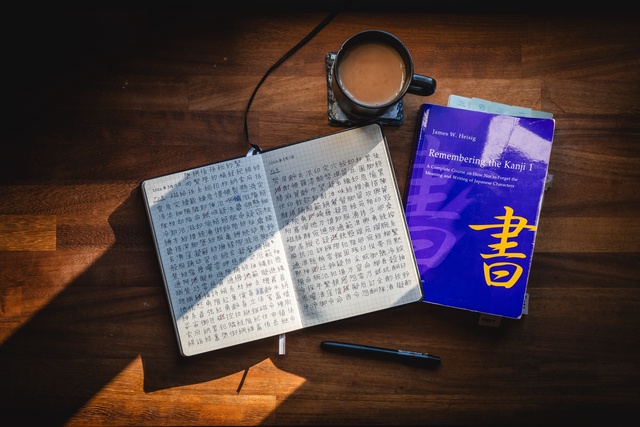
RTK is very clear that you should write every kanji as you learn it so I picked up a genkō yōshi notebook - the squared paper commonly used for practising Japanese writing, a couple of nice pens and some sticky notes from Amazon. I downloaded a pre-made RTK deck for Anki and, for the first time, I actually felt ready to start.
So, with just a book, a flashcard app and a couple of notebooks and a lot of determination, I started.
Sticking to the same routine every day
Very quickly, I fell into a routine.
Every morning started exactly the same. I'd make myself a cup of tea, sit down at my desk, open Anki and start working through my reviews before I did anything else.
If you've never used Anki before, it's a flashcard app built around a really clever idea. Every time you answer a card, it tries to work out when you're likely to forget it. Get something wrong and it'll show you again sooner. Get it right and it'll leave it for longer. Over time, it builds a review schedule that's unique to you.
It didn't matter whether there were fifty cards waiting for me or three hundred. I wasn't allowed to learn anything new until every single review had been completed.
Only then would I get on with the rest of my day.
As I mentioned in the previous post, RTK revolves around creating memorable stories for each kanji. What I hadn't appreciated at the time was just how much of my day those stories would end up occupying.
One thing I found myself doing naturally was reading ahead. Whenever I had a spare ten or fifteen minutes during the day, I'd pick up RTK and read through the next handful of kanji. I wasn't trying to memorise them yet, I was just trying to understand the stories and let them sit in the back of my mind.
Sometimes a story would jump out at me immediately.
Other times I'd spend hours with the same kanji floating around in my head, hoping something would eventually click. It became surprisingly common for me to be thinking about kanji while I was doing completely unrelated things.
Along the way, I realised that some types of stories worked far better than others. I'll come back to that in the next post because it ended up being one of the biggest lessons I learnt from RTK.
By the evening, I usually had a rough idea of how I wanted to remember the next batch of characters.
I'd sit down with my notebook, work through roughly twenty new kanji and carefully write each one a few times while thinking about the story I'd attached to it. At this point, I was simply following the process laid out in the book as closely as I could.
Then I'd close the notebook...
...and the next morning I'd do exactly the same thing again.
The system shaped itself
When I started RTK, I thought I'd already figured out my study routine.
I hadn't.
The overall structure stayed exactly the same but the finer details changed.
For example, the deck I'd downloaded contained all 2,200 kanji in one giant list - this is perfect if I had already finished the book. But I was adding 20-30 kanji per day. So I used tags and created what Anki calls a filtered deck. Don't let the name put you off - all that really means is I only reviewed the kanji I'd actually reached in the book rather than seeing cards from hundreds of pages ahead.
But fairly early on, I noticed a bigger issue. Something that was going to have a pretty big impact on the way I was studying.
I was becoming much better at recognising kanji than I was at writing them.
I needed to be writing more so I got a second notebook and, during my morning reviews, I would write every card I saw. I now had two books; one where I wrote the kanji for the first time and a notebook which was allowed to be messy and where mistakes were okay.
I also duplicated every Anki card and added a second version that worked in reverse. Instead of seeing the kanji first, I'd only see the English keyword and have to write the character from memory before revealing the answer.
That single change completely changed the way I studied.
It essentially doubled my review workload overnight but it also highlighted something I'd never even considered before. Recognising a kanji and being able to write one are two very different skills. I considered both to be just as important as each other, so the extra workload was simply something I had to accept.
Then I was on my own
When I got to part three of the book, I needed to make another change.
For context, Remembering the Kanji is broken up into three parts. Part one, Stories, where Heisig tells you his stories in detail for the first 294 characters. Part two, Plots, where he gives you ideas to work with for the next 298 characters and you shape them into something that works for you. Then finally, part three, Elements, where he more or less sets you free on the remaining 1,608 characters. He simply tells you the components of a kanji and leaves you to create your own stories from scratch.
Remember when I told you that people say the first 600 are easy and the rest fly by?
This is what they mean.
Being set free is great if you're super creative.
I'm not.
And let me tell you, some of these kanji are so abstract that making a memorable story is anything but straightforward. These people say it gets easier from here but, for me, although I managed to stay on pace, the mental load nearly tripled.
This was the point where I realised making the stories was becoming just as difficult as remembering the kanji themselves.
The best way to understand this is to try it yourself. Give it a go. Take the the words cocoon and clothes hanger and make a story which helps you vividly remember the word Phantasm.
This is where I found Kanji Koohii, an online RTK community where people share the stories they've created. It quickly became one of my favourite resources because, although I rarely copied anyone else's stories, seeing how somebody else had approached the same kanji was often enough to spark an idea of my own.
When I got more comfortable making stories, I also started leaning heavily on JapanDict, an online Japanese dictionary that lets you see how kanji are actually used in real words. That made it much easier to create stories that related to how I'd eventually encounter those kanji outside of RTK.
But that's a topic for the next post.
Staying Consistent
One final thing I want to talk about before I wrap this up is consistency.
One thing I learnt quite early on was that missing reviews was far more damaging than missing new kanji. If I skipped learning twenty new characters one evening, all I'd really lost was a day's progress.
Missing reviews was a completely different story.
If I finished Monday with 120 reviews due and ignored them, Tuesday didn't replace those 120. It added another day's worth on top.
Miss another day... Well, good luck.
Having a book with 2,200 characters also means you're not going to reach your goal for a very long time. I found that quite demotivating, so I started setting myself smaller milestones instead. My friend is visiting on this date and I want to have reached this chapter. My girlfriend is coming to stay, so I'd like to be around kanji #1220 before she arrives.
Those little goals always felt much more achievable than simply telling myself to "finish the book."
I also decided to start posting my progress on Instagram.
RTK is actually quite a lonely thing to do. You spend months sitting on your own making stories and reviewing flashcards, so sharing the journey gave me another reason to keep turning up. It wasn't about showing off, it was just another little reminder to myself that I'd committed to this and I wanted to see it through.
Consistency also doesn't mean being 100% all the time.
When I knew my girlfriend was coming over for a few weeks, I set myself a goal to reach before she arrived and then I stopped learning new kanji while we were together.
That didn't mean stopping my reviews though.
Remember, miss a few days of reviews and your backlog quickly becomes overwhelming. By continuing those every morning, I could enjoy the time we had together without worrying that I'd be coming back to an impossible mountain of cards.
Sometimes we'd even do the reviews together, which, admittedly, is one of the perks of having a Japanese girlfriend. Although I appreciate that's probably not an option for everyone... sorry!
Looking Back
Looking back now, there wasn't anything particularly revolutionary about the way I studied RTK.
I didn't have some secret technique. I wasn't studying eight hours a day and I certainly wasn't learning 2,200 kanji in six weeks.
What I did have was a routine that slowly evolved alongside me. Every time I found something that wasn't working, I changed it. Every time I found something that did, I kept it. Six months later, all of those small adjustments had become a study system that fitted the way I learn.
That doesn't mean it'll be the right system for you.
In fact, if there's one thing I hope you take away from this post, whether it's the people online claiming they finished RTK in six weeks, the genuinely helpful creators sharing their experiences on YouTube, or even this post itself, it's this:
Don't blindly copy somebody else's routine.
Steal ideas, absolutely. Keep what works. Throw away what doesn't. Build a system around the way you learn, not the way someone else does.
In the next post, I want to go a step further.
Now that I've finished RTK, there are quite a few things I wish somebody had told me before I started. Things like what makes a good mnemonic, why some stories stick while others disappear completely, when it's okay to change Heisig's keywords and the mistakes that cost me time along the way.
But before we get to that, there's one final thing worth saying.
Finishing Remembering the Kanji didn't mean I'd finished learning kanji.
If anything, it was the point where the real work began.